Waku Ken-Opurum
02 — FieldSim ↓ 01 — CLAIR ↓ 04 — Under the Mangrove ↓ 03 — MS ERICA ↓

Building technology in service of people and the planet.

I build instruments, materials and models for healthier places, more resilient communities and a more sustainable world — with the people most affected at the centre.

SCROLL
RESEARCH

PhD candidate (ABD) in Architecture-Engineering-Construction Management at Carnegie Mellon, finishing 2026.

VENTURES

Founder & CEO of CLAIR. Co-Founder & Chief Strategy Officer of FieldSim.

NOW

Writing a preprint on the CLAIR LLM work and preparing for my doctoral defence.

Channels

Four live lines of work. Each one senses something, models it, and turns it into a decision.

Passive, biodegradable air filtration · clair.earth ↗

Clean air usually arrives as an appliance: a purifier, a cartridge, a power draw. CLAIR (Clean Air Innovation for Resilience) is a plant-based nanofibrous material that filters incoming air through passive ventilation instead, so the window becomes the filter. No electricity while it runs, compostable when spent. The media is still under experiment in the lab.

We spin it ourselves on a benchtop electrospinning rig, iterating across polymers, fibre morphology, gradient porosity and photocatalytic coatings. Deciding what to spin is its own problem — the evidence sits across hundreds of papers, and no two report the same properties the same way.

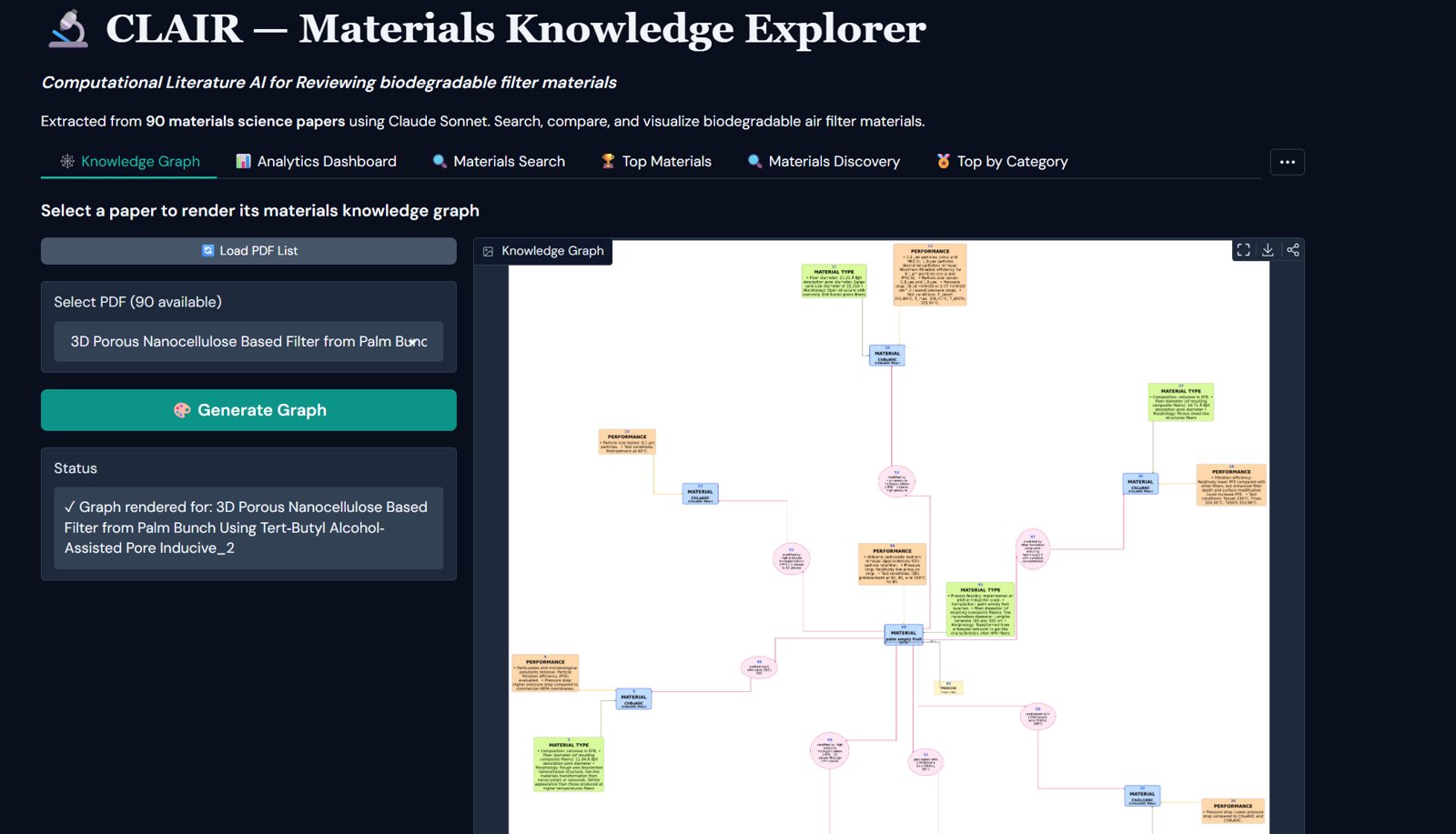
So we built the Materials Knowledge Explorer: an internal tool that reads the literature with a language model and turns it into a searchable, rankable database. Lab time then goes to what the evidence already favours, rather than to whatever the field happens to discuss most.

STAGE
TRL 3–4 · concept to validated prototype
CORPUS
90 papers processed
RELATIONSHIPS
5,942 extracted
MATERIALS
849 primary indexed
DISCOVERY
100+ NSF I-Corps interviews
AWARD
Scott Institute inaugural · $15K
ACCELERATOR
NextCorps Manufacturing
RECOGNITION
Hello Tomorrow Deep Tech Pioneer

FIG 1.1 — Knowledge graph from a single paper, linking materials to processes and measured performance

CLICK A FRAME TO ENLARGE

Agricultural digital twin, from Idaho National Laboratory · fieldsim.ai ↗

FieldSim began as path-optimisation research at Idaho National Laboratory and came out of the Department of Energy's BOOST programme as a company. It fuses satellite imagery, GPS, LiDAR terrain, machine telematics, weather and soil moisture into a digital twin of a field, then answers the question a grower actually has: when do I go in, and how should the machine move once I do.

Twenty-five discovery interviews told us the original single-point optimisation thesis was too narrow to build a company on. We concluded it, redirected towards interoperability and decision support, and validated the new direction in Montana.

This July the software ran on a tractor's autosteer system at a 600-acre research farm near Bozeman, planning the drive path for a 90-foot sprayer. Montana's fields are hilly and irregular — exactly where straight-line GPS guidance wastes the most fuel and chemical.

DOE BOOST
2nd place, 2025
LICENCE
Exclusive exploratory R&D · INL
NON-DILUTIVE
$69K · FedTech $50K, U.S. EDA $19K
PILOT
600 acres · Montana State Univ.
PLANNING
7-day operational window
NETWORK
Grand Farm · The Combine
FIG 2.1 · VIDEO
FIG 2.1 — Prototype walkthrough: field geometry, machinery paths, and multi-day operational planning

Mobile Sensing Educational Robot for Indoor Climate Assessment

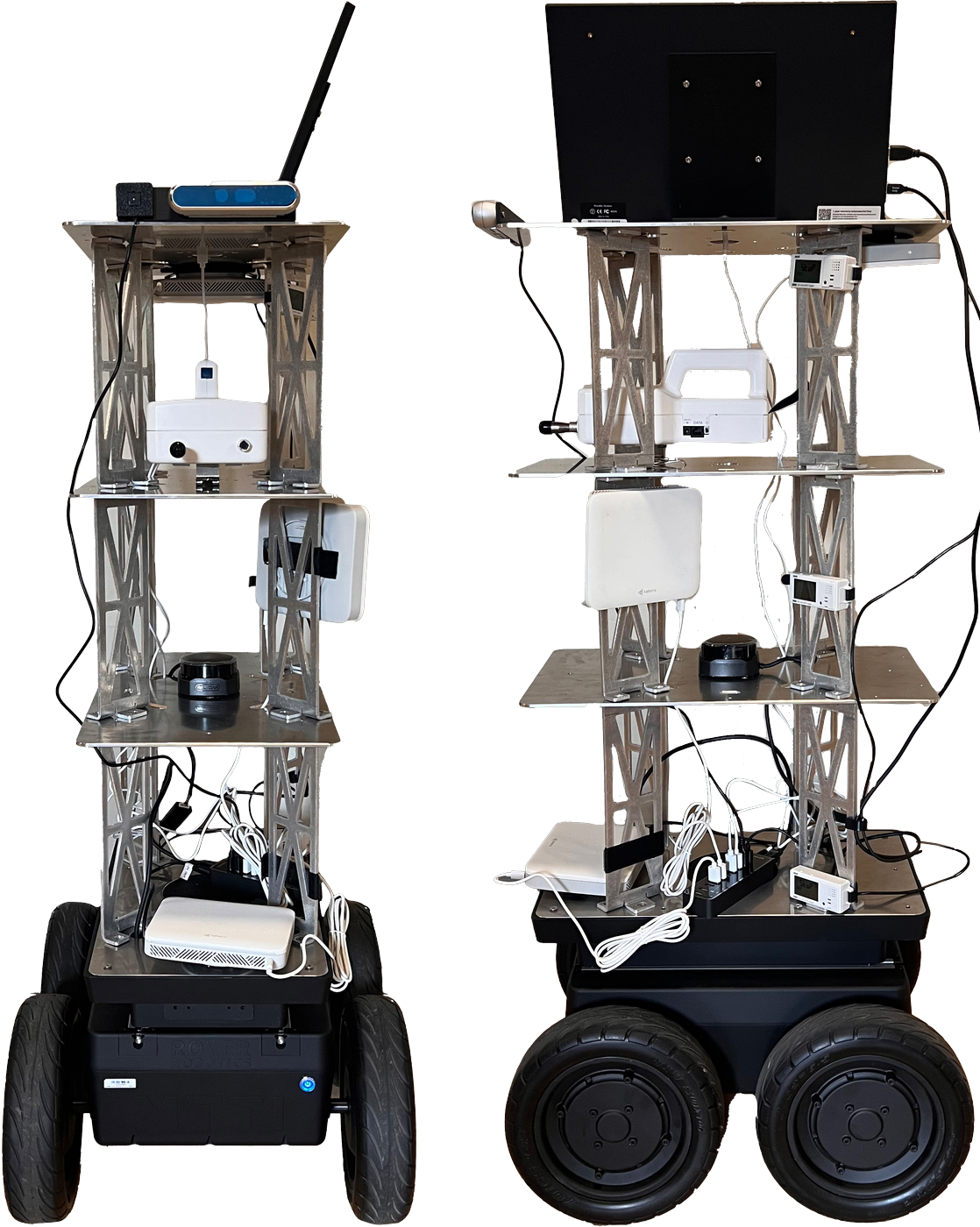
A robot that patrols a building, maps what it finds, and reasons over the result with a multimodal language model — depth and thermal cameras, LiDAR, and a multi-pollutant sensor suite on a four-wheel rover base.

MS ERICA is led and owned by Dr. Erica Cochran Hameen, the project's principal investigator, at Carnegie Mellon's Center for Building Performance & Diagnostics.

On her team, I led field assessments with it across Pittsburgh building types, from offices to a public works building, and serve as the air-quality subject-matter expert for its recommendation layer: what the system should infer from its sensor streams, and what it ought to tell the people in the room.

PARTICULATES
Kaiterra × 3 heights · PM1, PM2.5, PM10
GASES
Greywolf · CO₂, VOCs, PM
THERMAL
HOBO MX · Temp / RH
VISION
Intel RealSense RGB-D
MAPPING
LiDAR S2
PI & LEAD
Dr. Erica Cochran Hameen

FIG 3.1 — The current build: particulate monitors at three heights, CO₂ and VOC sensing, depth camera, LiDAR, temperature and humidity logging

CLICK A FRAME TO ENLARGE

Sensing, participatory design, and storytelling as method

The Niger Delta is among the most under-monitored places on earth for air quality, and among the most affected by gas flaring and soot. My dissertation builds a framework I call environmental griotship: low-cost sensing in the hands of local data collectors, participatory design, and the region's own storytelling traditions as the medium through which data returns to the people who generated it.

The instruments are GPS-enabled multi-pollutant monitors on a compact FeatherWing platform, in an enclosure I designed and printed, calibrated against reference-grade equipment. The outputs are not only datasets: they became Under the Mangrove, a public VR exhibition co-designed with HCI researchers. A conversational layer now sits over the dashboard so a resident can ask what their own readings mean — which makes the device itself a kind of storyteller.

SENSES
PM2.5, PM10, VOC, CO₂, CO, SO₂, NO₂, T, RH
PLATFORM
FeatherWing · GPS-enabled
ENCLOSURE
Designed & 3D-printed in-house
GRANT
Frank-Ratchye Further Fund · $5K
SCHOLARSHIP
Louis F. Valentour Travelling Scholarship · $6,500, 2024
VR EXHIBITION
Under the Mangrove
FIG 4.0 · VIDEO
FIG 4.0 — Under the Mangrove: a VR exhibition built from community-collected air-quality data
DISSERTATION COMMITTEE
  • Erica Cochran Hameen, PhD · Chair
    Associate Professor, Carnegie Mellon University
  • Kristen Kurland
    University Professor, Carnegie Mellon University
  • Kristin Hughes
    Professor, Carnegie Mellon University
  • Richard Nisa, PhD
    Faculty, Carnegie Mellon University
  • Ralph Muehleisen, PhD
    Chief Building Scientist, Argonne National Laboratory

FIG 4.1 — Housing with internal sensor frame

CLICK A FRAME TO ENLARGE
02 — ABOUT

Researcher by training. Builder by habit.

Portrait of Waku Ken-Opurum WAKU KEN-OPURUM

I work where applied machine learning, sensing systems and environmental data meet. For five years I've set research agendas across a DOE national laboratory, a university research centre and two startups.

I build end-to-end systems rather than prototypes alone: LLM extraction pipelines and knowledge graphs over scientific literature, ML-corrected sensor networks, simulation platforms fusing geospatial data, and conversational interfaces that put model outputs in the hands of people who aren't experts.

At Carnegie Mellon's Center for Building Performance & Diagnostics I lead field studies across many kinds of buildings, and I train students in field methods, data acquisition and analysis.

PH.D.
AEC Management · Carnegie Mellon · exp. 2026
M.S.
Technology Management · Columbia
B.S.
Management & Intl. Studies · Indiana Kelley, Highest Distinction
03 — EXPERIENCE

Readings over time

  1. 2025 — NOW
    Co-Founder & Chief Strategy Officer
    FieldSim · Remote

    Lead strategic partnerships and define technical direction for a digital-twin platform built on Idaho National Laboratory research. Facilitated partnerships with Idaho National Laboratory, Montana State University, Headwaters Tech Hub, the Grand Farm ecosystem, The Combine, and a Wisconsin farmer design partner.

  2. 2024 — NOW
    Founder & Chief Executive Officer
    CLAIR

    Run four workstreams across materials science, ML/software, manufacturing and building science. Built the benchtop lab and the LLM materials-discovery pipeline; recruited a CTO, a COO and three CMU faculty advisors.

  3. 2024
    Yale Environmental Fellow
    Union of Concerned Scientists · Remote

    Turned technical literature and stakeholder interviews into an internal position statement on California Cap-and-Trade reauthorisation, and presented it to policy and scientific audiences.

  4. 2023
    Sustainability & Resilience Intern
    City of Pittsburgh, Dept. of City Planning

    Built a Power BI dashboard cataloguing energy conservation measures across 10 city-owned facilities, for use by city managers in capital planning and reporting.

  5. 2022 — 2024
    National GEM Consortium Fellow
    Argonne National Laboratory · Office of the Director

    Modelled campus-scale energy systems in Python and ArcGIS Pro and evaluated decarbonisation pathways feeding Argonne's net-zero roadmap and the federal inter-lab strategy.

  6. 2021 — NOW
    Doctoral Research Lead
    Carnegie Mellon · Center for Building Performance & Diagnostics

    Lead field studies across many kinds of buildings; build ML pipelines for sensor calibration and correction; air-quality SME for MS ERICA (PI: Dr. Erica Cochran Hameen). Advised by Dr. Erica Cochran Hameen and Prof. Vivian Loftness.

HONOURS

Hello Tomorrow Deep Tech Pioneer · Scott Institute Entrepreneurship Award, inaugural · Louis F. Valentour Travelling Scholarship, 2024 · Frank-Ratchye Further Fund · NSF I-Corps Fellow · National GEM Consortium Fellowship · Yale Environmental Fellowship · Semifinalist, Chain Reaction Innovations · Finalist, CMU Three Minute Thesis 2024 · LEED Green Associate

04 — WRITING

Writing

Full list on Google Scholar ↗
  1. 2025
    Visualising the Breath of a Region: Humanising Air Pollution and Health Data through Informal Education in the Niger Delta
    8th International Adaptation Futures Conference, New Zealand
  2. IN PROGRESS
    Towards Responsible and Ethical Climate AI Modeling: A Community-Centric Approach
    With R. Kotamarthi, R. Wheeler-Grange and C. Negri · Nature Cities
  3. 2024
    Post-Occupancy IEQ Assessment of the Domenici Courthouse
    With V. Loftness, E. Cochran Hameen and others · Technical report for the U.S. General Services Administration
  4. 2020
    Designing an Appropriate Climate Health Interface for Guided Self-Diagnosis in Low-income Communities within Nigeria
    With B. Ken-Opurum and A. Idahosa · IEEE Global Humanitarian Technology Conference
  5. 2020
    The Implications of Physical and Technical Conditions on Flood Resilience in Self-Build Housing in Tropical Nigeria
    With B. Ken-Opurum and others · UNESCO Water, Megacities and Global Change